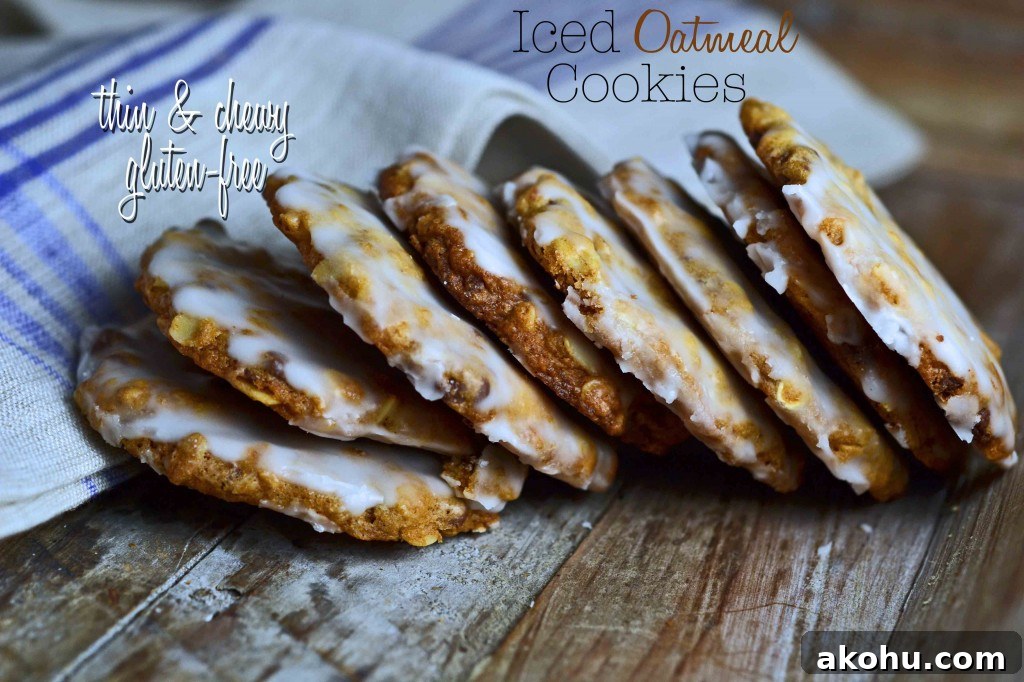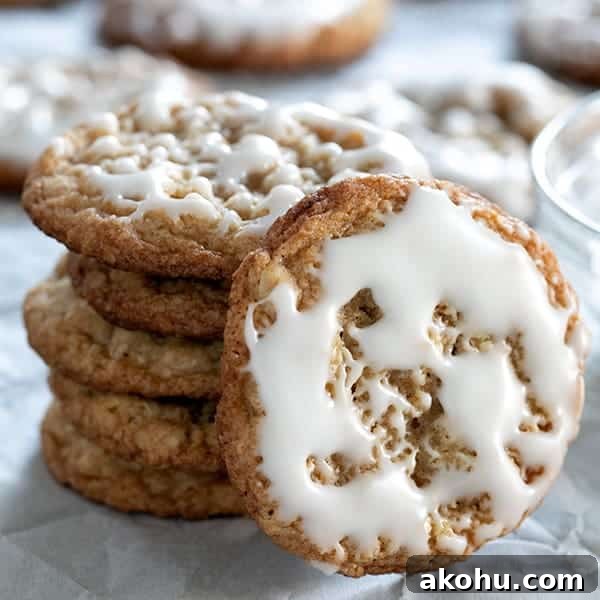
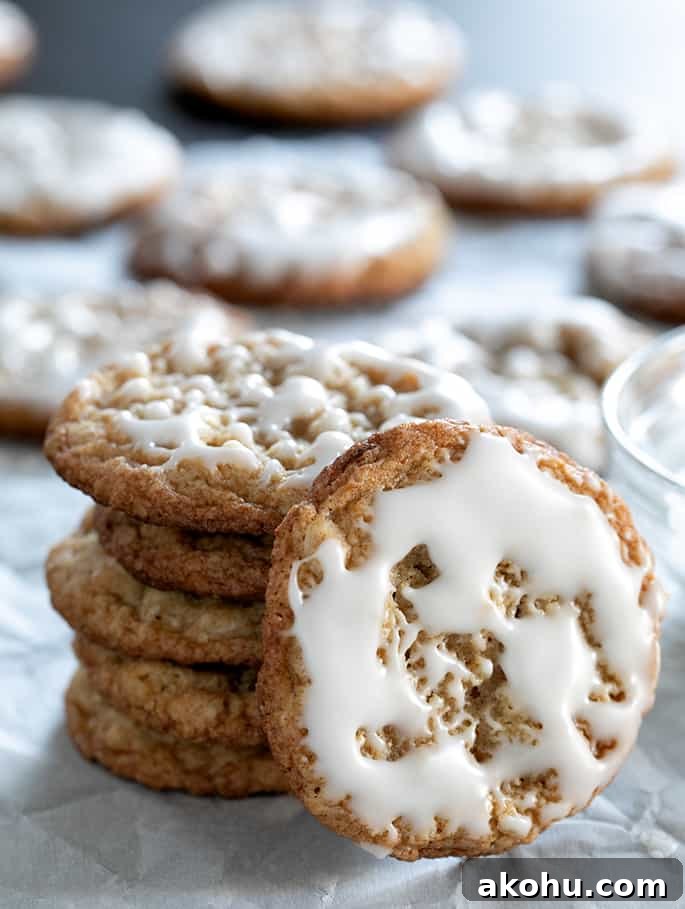
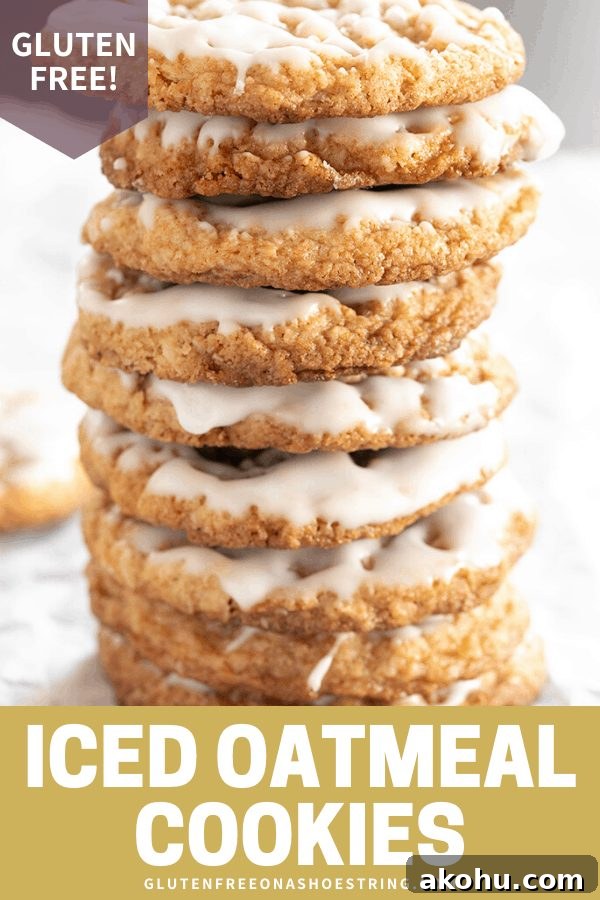
These easy gluten-free iced oatmeal cookies are crisp at the edges, soft and chewy in the center, and finished with a thin, glossy layer of icing that makes them lovely to serve.
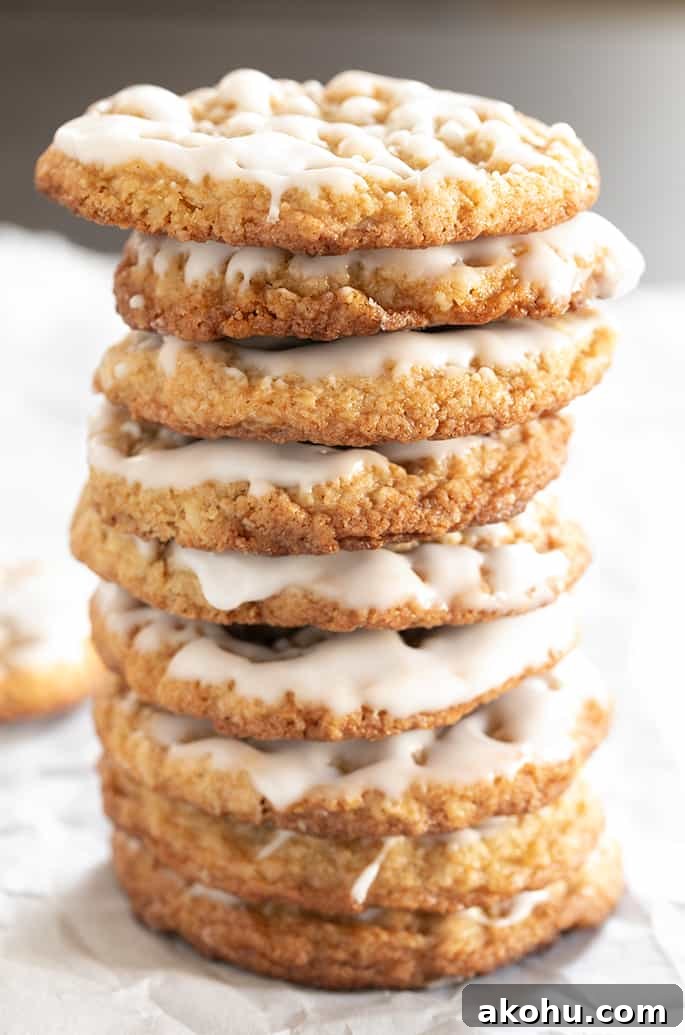
Iced oatmeal cookies are an old favorite
I used to love packaged Archway iced oatmeal cookies: chewy centers with a thin white icing. They were comforting, but their large, very soft size often made them fragile. These gluten-free iced oatmeal cookies capture that same nostalgia while improving on the texture. They’re smaller, crisp around the edges and bottom, and still tender and chewy inside.
Just a bit of icing
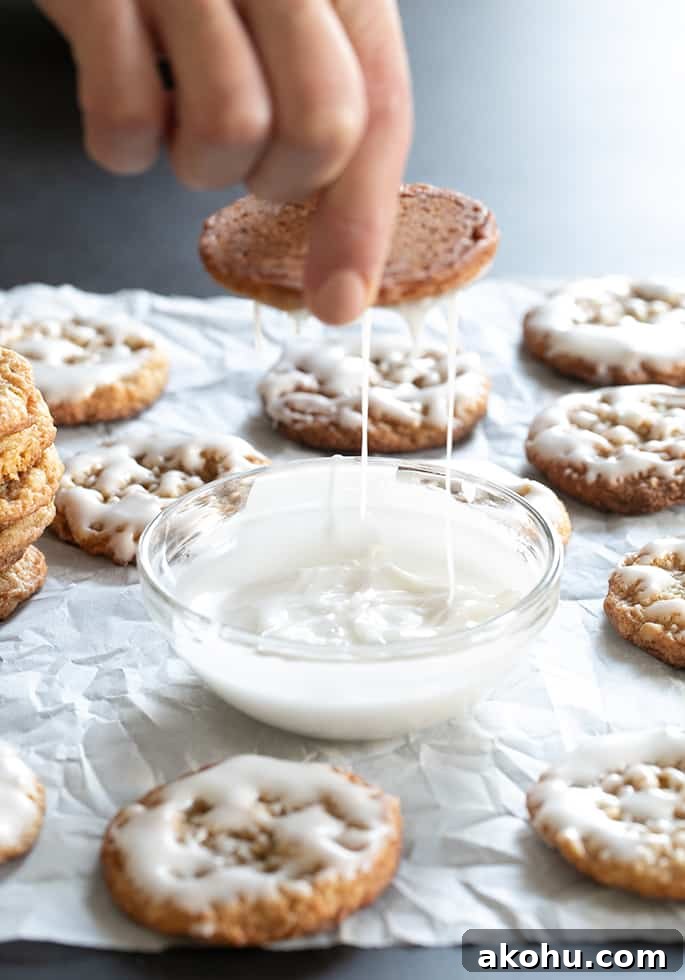
The glaze is intentionally simple: confectioners’ sugar, a touch of lemon juice, and water. It’s not royal icing since it contains no egg white or meringue powder, but the right consistency yields a smooth, matte coating that sets reliably. The trick is to start with a very thick paste, then thin it drop by drop until it becomes pourable. It’s much easier to thin a thick paste with a few drops of water than to thicken an over-thinned glaze.
These cookies look best when the icing is a little spotty, allowing the oatmeal’s craggy surface to show through — that contrast gives them character.
How to make these classic iced oatmeal cookies
These cookies benefit from properly combined wet ingredients for consistent texture. Beat the butter, sugars, and egg together until well combined — you don’t need to whip air into the mixture, but the ingredients should be smooth and evenly mixed. A stand mixer with a paddle attachment is convenient, and a handheld mixer works fine too.
Whisk the all-purpose gluten-free flour, xanthan gum (if your blend needs it), baking soda, salt, a pinch of cinnamon, and quick oats, then stir those dry ingredients into the wet mixture. The dough will be soft and sticky. Portion it using a spring-loaded ice cream scoop or two spoons; chill the scooped dough on a baking sheet so it becomes firm enough to roll. For best results, the shaped dough should be nearly frozen before baking.
Baking the cookie dough from frozen
The recipe requires baking from frozen because unchilled dough spreads too much and yields thin, uneven cookies. Portion the dough, chill it until it’s only slightly sticky, then roll into balls and freeze on the sheet until firm. Baking from frozen keeps the cookies thin but even and prevents them from melting into puddles in the oven.
If you prefer, you can freeze baked cookies (with or without icing) for later. This recipe, however, is designed so you can bake directly from frozen dough for a fresh batch with minimal lead time — about 10 minutes to preheat and 10 minutes to bake. A full-sized toaster oven could work if you’re making a small batch.

Baking gluten-free with oats
This is an oatmeal cookie, so certified gluten-free oats are assumed. I always buy certified gluten-free old-fashioned rolled oats and pulse them into quick oats when needed. For quick oats, pulse briefly so they remain slightly textured; for oat flour, pulse longer until fine. Oats bring chewiness and whole-grain flavor and can even replace some flour in other recipes.
If you need more detail about oats and gluten-free diets, consult reliable resources on that topic. In all cases, use certified gluten-free oats if you require a gluten-free diet.

Iced oatmeal cookies ingredients and substitution suggestions
Dairy-free
The only dairy in the cookie dough is 4 tablespoons (56 g) unsalted butter. Substitute a vegan butter (such as Melt or similar brands) or use a butter-flavored shortening if you prefer a dairy-free version.
Shortening
Texture depends on the combination of butter and shortening. The recipe uses non-hydrogenated vegetable shortening; Spectrum or Crisco are good options. Taste and performance can vary between brands, so choose one you like.
Egg free
If you need an egg-free version, replace the single egg with a chia “egg”: combine 1 tablespoon ground white chia seeds with 1 tablespoon lukewarm water and let it gel before adding to the dough.
Oats
If you must avoid oats, try a mix of flattened (beaten) rice flakes combined with quinoa or buckwheat flakes, though the results will differ and the cookies may spread more. In that case, reduce the flake amount and increase all-purpose gluten-free flour. Expect different texture and spread when changing the oat base.
Iced Oatmeal Cookies | Thin and Chewy
Ingredients
For the cookies
- ¾ cup (105 g) all-purpose gluten-free flour
- ½ teaspoon xanthan gum (omit if your blend already contains it)
- ½ teaspoon baking soda
- ¼ teaspoon kosher salt
- ¼ teaspoon ground cinnamon
- 3 tablespoons (36 g) granulated sugar
- ½ cup (109 g) packed light brown sugar
- 1 cup (110 g) gluten-free quick oats
- 4 tablespoons (56 g) unsalted butter, at room temperature
- 4 tablespoons (48 g) non-hydrogenated vegetable shortening, at room temperature
- 1 egg (50 g out of shell), at room temperature, beaten
- 1 teaspoon pure vanilla extract
For the icing
- 1 cup (115 g) confectioners’ sugar
- ½ teaspoon freshly squeezed lemon juice
- 1 to 2 tablespoons tepid water, plus more by the teaspoon if necessary
Instructions
-
Line a rimmed baking sheet with unbleached parchment paper and set it aside.
Make the cookies.
-
In a small bowl, whisk together the flour, xanthan gum, baking soda, salt, cinnamon, and oats. Set aside.
-
In a stand mixer fitted with the paddle attachment or in a large bowl with a hand mixer, beat the granulated sugar, brown sugar, butter, shortening, egg, and vanilla until well combined.
-
Add the dry ingredients and mix until combined. The dough will be thick, soft, and sticky.
-
Scoop portions of about 1½ tablespoons each using a spring-loaded ice cream scoop or two spoons and place the mounds close together on the prepared baking sheet.
-
Freeze the raw dough portions on the baking sheet for at least 30 minutes, or until the dough is firm and only barely sticky to the touch.
-
Remove from the freezer and roll each portion into a round between the palms of your hands.
-
When ready to bake, preheat the oven to 375°F (190°C).
-
Line rimmed baking sheets with unbleached parchment paper and arrange the frozen dough balls about 2 inches apart.
-
Bake one sheet at a time in the center of the preheated oven for about 10 minutes, or until the edges are lightly golden and the cookies hold an even thickness.
-
The centers may look slightly wet; remove the cookies and let them cool on the baking sheet until they firm up, then transfer to a wire rack to cool completely.
Make the glaze.
-
Place the confectioners’ sugar in a medium bowl.
-
Add the lemon juice and 1 tablespoon of water, stirring until it forms a thick paste.
-
Add more water a little at a time until the icing is smooth and thickly pourable. If you add too much water, balance the texture with more confectioners’ sugar.
-
Working with one cooled cookie at a time, turn it over and hold it by the edges. Dip the top into the icing without immersing the cookie, and allow excess to drip off.
-
Place the cookie icing-side up on a flat surface and repeat with the remaining cookies. The icing will firm at room temperature; thicker spots may remain slightly soft beneath the surface.
Notes
Originally posted on the blog in 2012. Photos and video updated in 2019; recipe adjusted to make a smaller batch.
Nutrition information is automatically calculated and should be used as an approximation.