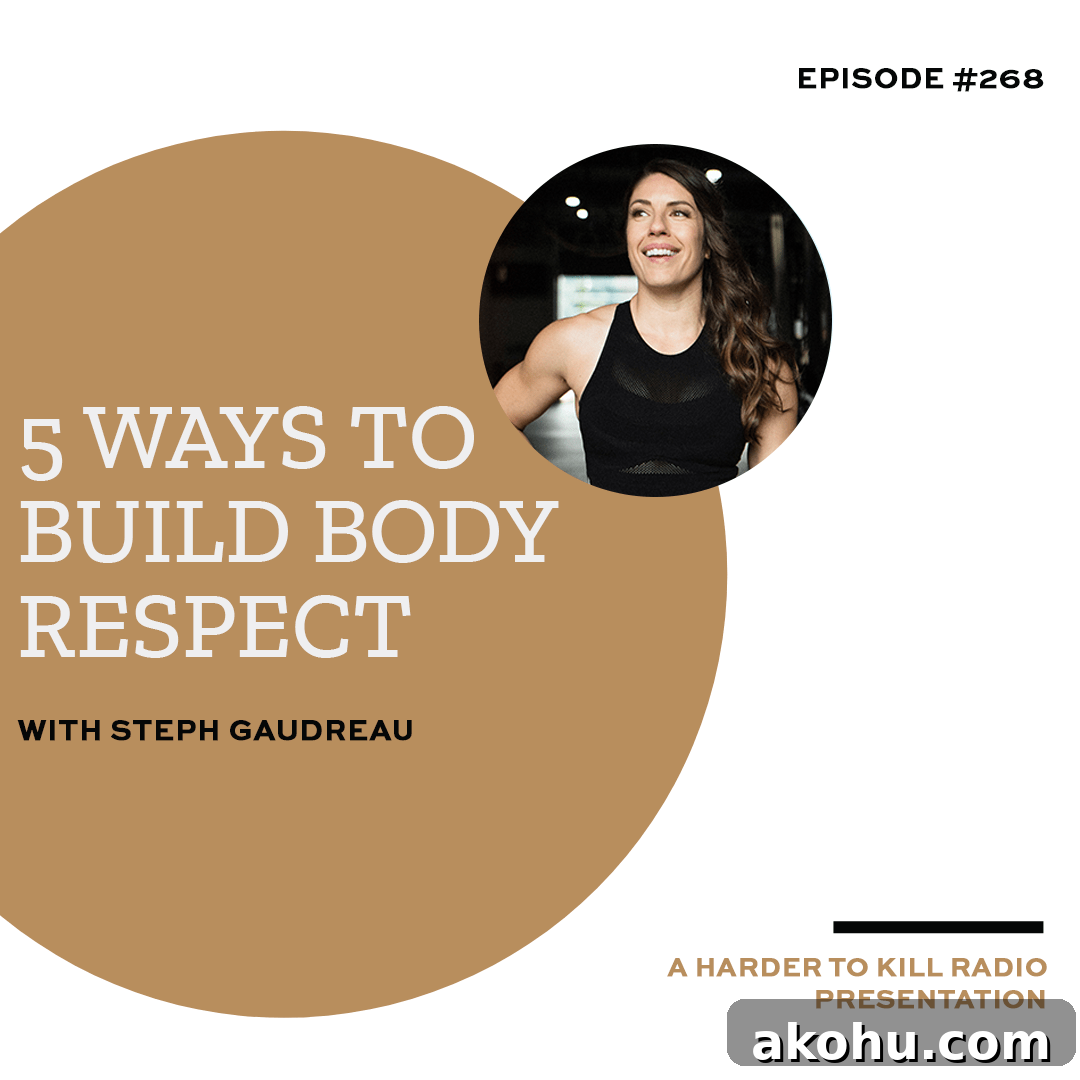
Building body respect means returning to a calmer, more natural relationship with your body—without shame or negativity. It requires unlearning the messages diet culture and society have taught us about appearance and embracing the truth that your body is only one part of who you are.
Click play to listen right on this page, no app needed:
Or, listen on your favorite app: iTunes (Apple Podcasts) | Spotify | Stitcher | Overcast | CastBox | TuneIn | Google Play | I Heart Radio
Your Body Is One Small Piece Of Who You Are
In this episode, Steph Gaudreau discusses five practical ways to begin building body respect for yourself and others. These strategies help you move away from shame and toward acceptance, listening to your intuition, and cultivating a healthier day-to-day relationship with your body.
Your body is not the most important thing about you, despite what diet culture insists. By recognizing your intrinsic worth beyond appearance and practicing gratitude for your here-and-now body, you can develop a kinder, more sustainable approach to nutrition, movement, and self-care.
Ready to start building body respect and clarifying who you are beyond your body? Visit the episode page and share the steps you’re taking in the comments.
On Today’s Episode
- Understanding the difference between body positivity and body neutrality (10:37)
- Why you should stop body checking and measuring yourself and others (16:10)
- Tips for shopping so your clothes fit your here-and-now body (20:34)
- The importance of awareness when shifting toward positive thoughts (23:50)
- How to create new habits and embrace gratitude for your body (25:20)
Resources Mentioned In This Show
HTK 266: How To Listen To Your Body
HTK 252: Why It’s Important To Dress For Your Here and Now Body
Nutritional Therapy Association Website
Join the Core 4 Facebook Club
Quotes
“We can be critical of the diet culture while having compassion for people who are moving through this process on their own.” (6:48)
“Soon after we enter this world, we start to lose our own abilities as an intuitive eater, but that is our default state.” (9:02)
“When you are faced every day with putting on the pair of whatever clothing item is not fitting your here and now body, for a lot of people this only kicks the day off with anxiety and the not good enough-ness.” (19:27)
“Your worth is not in the size of your body, it’s not. And I know that that is hard for a lot of us.” (21:36)
“Who are you aside from just your body? I bet if you asked your five closest friends what they appreciate most about you, they wouldn’t list the size of your body.” (29:02)
Sponsor Message
Harder to Kill Radio is sponsored by the Nutritional Therapy Association. Registration is open for the NTA’s Nutritional Therapy Practitioner Online Program, which emphasizes whole foods, nutrient-dense frameworks, sleep, movement, and stress management. Mention Steph’s name on your application.
You can also try the free 7-day course, Nutritional Therapy 101.
5 Ways To Build Body Respect w/ Steph Gaudreau FULL TRANSCRIPT
This episode explores five actionable approaches to build body respect. Steph introduces herself and outlines how she helps people build strength, trust, and self-worth without restrictive dieting or punitive exercise. With millions of downloads, Harder To Kill Radio continues to share perspectives on nutrition, movement, and mindset from a place of nourishment.
Steph explains that intuitive eating and body respect are learned practices. Even though intuitive eating is an innate ability, many of us lose those cues early in life due to caretakers or cultural messages that promote dieting. Reclaiming intuitive awareness and body respect is an unfolding process that takes time and curiosity rather than blame.
She clarifies terminology—body positivity, body neutrality, body respect—and emphasizes the origins of the body positivity movement as a reclamation by people in larger bodies. Using accurate terms matters because the movement was created to protect and center people who have historically been marginalized for their size. Body neutrality and body respect are practical approaches that focus on appreciating what your body does without requiring constant, performative love.
Many people begin this work by removing the scale, but Steph notes that stopping weigh-ins is only one step. It’s common for people to replace weighing with other monitoring behaviors. The five practical strategies she outlines are intended to address those broader patterns:
1. Stop body checking
Body checking—constantly examining or measuring parts of your body—reinforces anxiety and dissatisfaction. This includes using your hands as calipers, pinching, or repeatedly scrutinizing specific areas. While looking in a mirror isn’t inherently wrong, repeated, judgmental checking keeps you stuck in comparison and self-criticism.
2. Get clothes that fit your here-and-now body
Holding onto clothes that are too small (or too large) turns garments into measuring tools that trigger shame. Wearing clothes that fit comfortably reduces daily anxiety and frees you to focus on living. Steph acknowledges shopping can be uncomfortable for many reasons, but having a few pieces that fit and feel good can make a big difference.
3. Catch and reframe negative self-talk
Your thoughts and words shape feelings, and feelings shape behavior. Start by noticing negative statements you make about your body and reframe them to neutral, compassionate, or functional observations. Extreme “flip-it-to-positive” approaches may feel inauthentic; instead aim for realistic, neutral reframes that reduce emotional reactivity and support sustainable change.
4. Remove media that obsessively focuses on weight
Unfollow, mute, or limit shows and accounts that constantly discuss weight loss or idealized bodies. These feeds tend to fuel comparison and reinforce the idea that worth is tied to size. If certain media isn’t serving you, cut it out and replace it with content that supports your well-being.
5. Journal or meditate on who you are beyond your body
Reflect on the qualities that define you aside from appearance. Ask friends who truly know and love you what they appreciate about you—chances are size won’t be mentioned. Practicing this perspective helps re-center identity on skills, values, relationships, and character, rather than physical attributes.
Steph underscores that body respect doesn’t mean ignoring health or bodily needs—rather, it invites a balanced relationship with the body as one important part of a broader self. Progress is gradual: awareness, small habit changes, and kinder self-talk compound over time.
Recap: five ways to build body respect—stop body checking; wear clothes that fit your here-and-now body; reframe negative thoughts to neutral or realistic statements; remove media that fixates on weight; and clarify who you are beyond appearance. Steph invites listeners to share feedback in the Core 4 Club on Facebook and to subscribe to the podcast.
Join the Core 4 Community
- Join the Core 4 Club on Facebook
- Sign up for the weekly newsletter for new podcast alerts and more
Thanks for Listening!
- If you enjoy the show, please take a moment to subscribe to the podcast—it helps others discover the content.